
27/02/2026 - Press release
Elevated levels of lipoprotein(a), a component of cholesterol in the blood, are associated with a higher risk of heart attack or other cardiac conditions. For this reason, a recent study by the Hospital del Mar Research Institute proposes measuring its levels in all patients, not only those already receiving treatment after experiencing a cardiac event. The study, published in the American Journal of Preventive Cardiology, is based on data from more than 1,000 patients followed at Hospital del Mar. It is one of the first epidemiological studies focusing on this lipoprotein conducted in Spain.
Researchers analyzed lipoprotein(a) levels in two groups: patients followed after a heart attack or other cardiac event (the RiskOpACS cohort - Risk Optimization following an Acute Coronary Syndrome) and the USE-IT cohort, consisting of individuals with detected coronary atherosclerosis but no previous symptoms. Dr. Mateo Iwanowski, cardiologist at Hospital del Mar and researcher in the Biomedical Research in Heart Diseases Group, explains: "We observed a high prevalence of lipoprotein(a) in patients who had already experienced a cardiovascular event, as expected. However, prevalence was also very high among individuals without prior events but with cholesterol deposits in their coronary arteries. In fact, it was closer to that of post-infarction patients than to the general population."
According to the results, in individuals who have experienced a cardiovascular event, having elevated levels of this lipoprotein in the blood is associated with a 40% higher probability of developing multivessel coronary disease. This pattern is also observed in patients without cardiac symptoms but with atherosclerosis, who show similarly high levels to those who have already suffered a cardiovascular event. In addition, individuals with higher blood levels of this lipoprotein also present increased calcium levels in their blood vessels, another clear indicator of cardiovascular risk.

The Lipoprotein Study Team
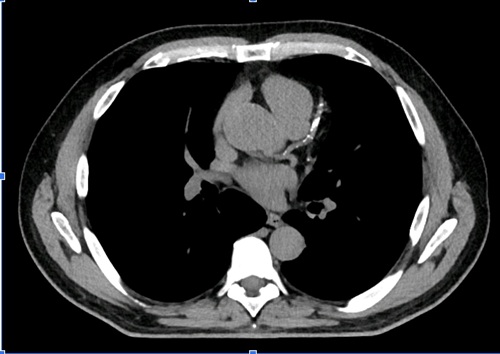
Non-contrast chest CT scan showing extensive calcification in the coronary arteries
Personalized follow-up
Lipoprotein(a) levels are genetically determined and are not influenced by diet or lifestyle. They also remain relatively stable throughout life. Dr. Miguel Cainzos-Achirica, Head of Preventive Cardiology at Hospital del Mar and coordinator of the Biomedical Research in Heart Diseases Group at the Hospital del Mar Research Institute, notes: "Our study reinforces that lipoprotein(a) levels in our population are high not only among patients who have suffered a heart attack, but also among asymptomatic individuals with significant atherosclerotic plaque burden."
The authors therefore recommend systematically measuring lipoprotein(a) levels in the population, particularly in higher-risk groups such as women, who tend to have higher concentrations. This can be done through a simple blood test. "If high levels are detected, a more intensive and personalized cardiovascular prevention strategy can be implemented," explains Dr. Iwanowski.
At present, there is no specific treatment available to control lipoprotein(a) levels in the blood, and it has not yet been proven that lowering these levels is an effective strategy to reduce cardiovascular risk. Several clinical trials are currently underway to determine this. Until results become available, the recommended approach is closer and more intensive monitoring of all modifiable risk factors in individuals found to have elevated levels, in order to reduce their overall risk of a cardiovascular event.
Reference article
Iwanowski M, Ruiz-Bustillo S, Vime-Jubany J, Zuccarino F, Cainzos-Achirica M, et al. Lipoprotein(a) epidemiology and role in secondary and primary-and-a-half cardiovascular prevention: From subclinical atherosclerosis to coronary events. American Journal of Preventive Cardiology. In press, corrected proof, available online 24 January 2026. doi:10.1016/j.ajpc.2026.101416.
© Institut Hospital del Mar
d'Investigacions MèdiquesLegal Notice and Privacy Policy | Cookie Policy | Site Index | Accessibility | Find Us | Contact