
16/01/2026 - Press release
Senescent cells-those that stop dividing and accumulate in our bodies with age, also known as "zombie cells"-play a decisive role in tumor proliferation, according to a preclinical study led by researchers from the Hospital del Mar Research Institute, the Vall d'Hebron Institute of Oncology (VHIO), and the CIBER Oncology area (CIBERONC), published in the journal Science Advances. The findings open the door to a new combination of treatments to slow tumor growth and prevent the development of metastases.
The researchers used animal models to analyze the role of these cells in the growth of breast cancer tumors. To this end, they developed a new transgenic mouse model that enables a more precise study than previously available models. This approach allowed them to assess how the cells involved in tumor development respond to the elimination of senescent cells.
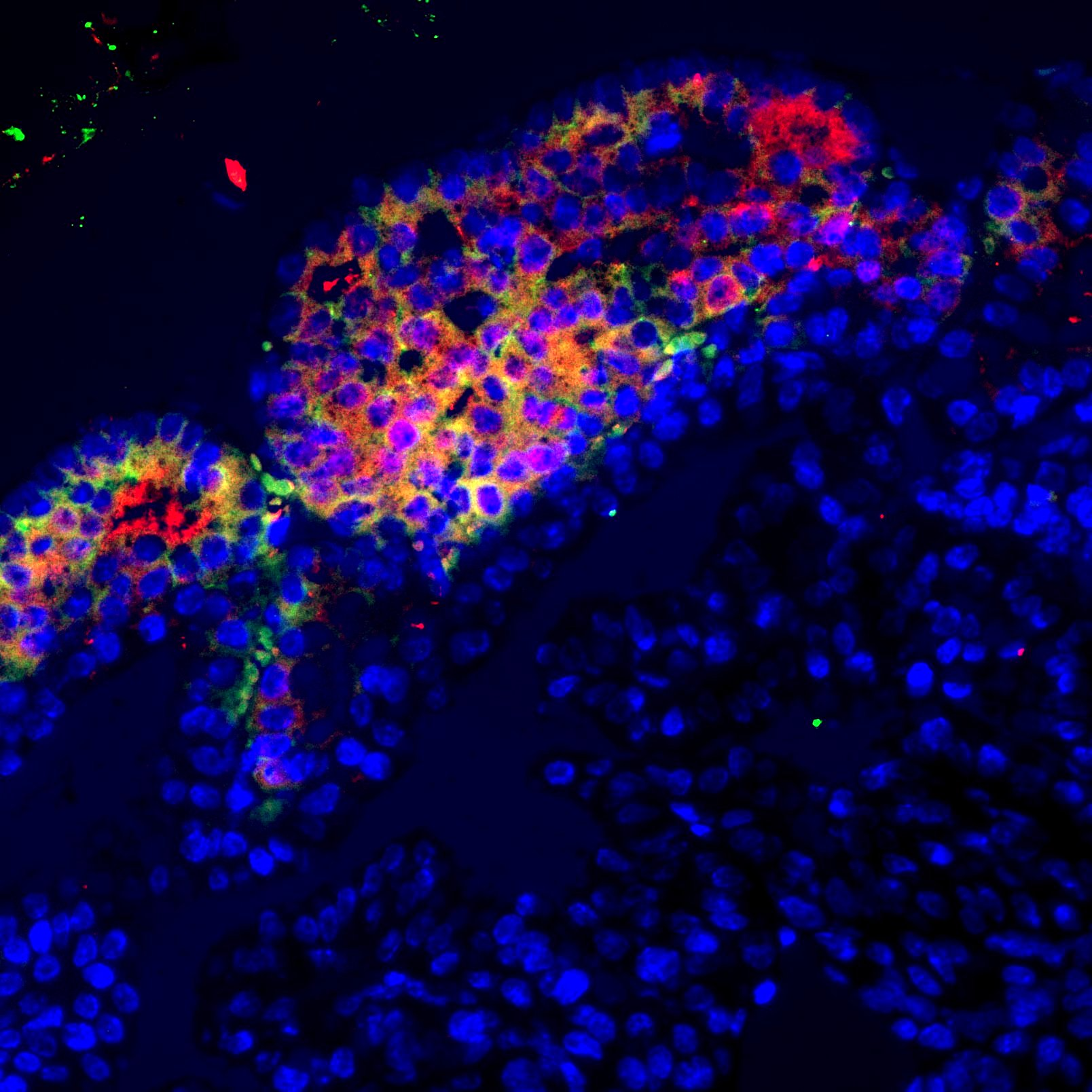
Immunofluorescence showing senescent cells in one of the early-stage mouse tumors.
What they observed is that eliminating these cells at an early stage of tumor development promotes tumor proliferation and the formation of metastases. This occurs through macrophages-cells of the immune system-which, in the absence of senescent cells, attach to the tumor and support its growth. The key factor is the expression by these macrophages of a specific molecule, the cytokine CCL2, which promotes the proliferation of cancer cells and which macrophages have little capacity to produce when they are inhibited by senescent cells. As a result, the body's own defenses end up protecting the tumor from the immune system's action, since macrophages, in the absence of senescent cells, block the activity of T lymphocytes, which are responsible for attacking cancer cells.
A new potential treatment
The results obtained have led Marta Lalinde Gutiérrez, a researcher in the Immune Redirection Research Group at the Hospital del Mar Research Institute, to warn about the growing interest in anti-aging therapies based on the elimination of senescent cells. "Eliminating senescent cells in the context of anti-aging treatments may pose a risk in the presence of early tumor lesions," she explains, noting that these cells may play a role in monitoring and protecting against tumor cells-a role that is lost when they are removed.
At the same time, the researchers also found that targeting these cells at the early stages of the tumor process, in combination with inhibitors of the CCL2 molecule, has a positive effect, reducing tumor size and eliminating metastases. Thus, "combining the elimination of senescent cells with a treatment targeting the CCL2 molecule may be beneficial against breast cancer at the initial stages of tumor development," says Marta Lalinde Gutiérrez.
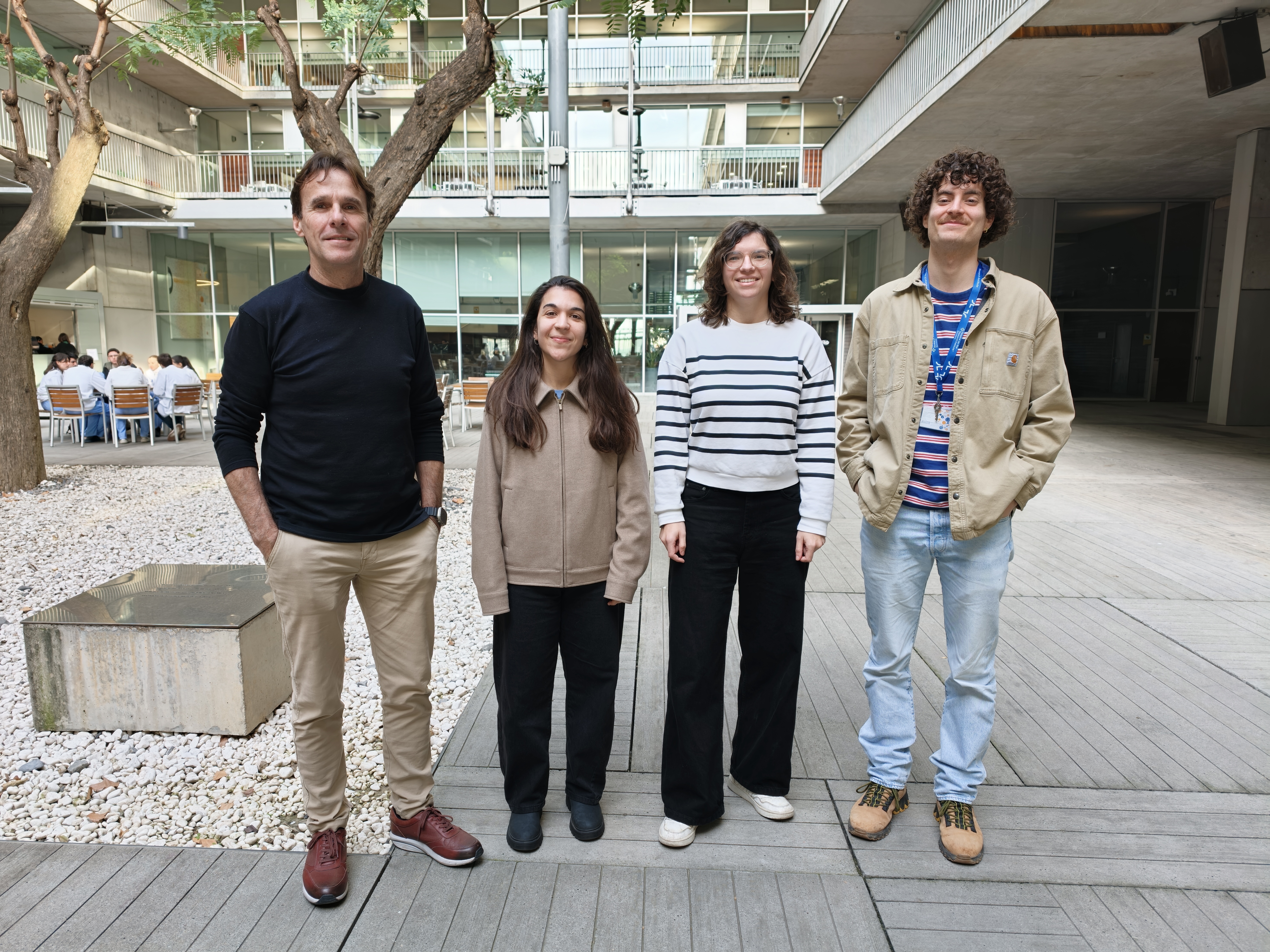
From left to right: Joaquín Arribas, Sandra Pérez-Ramos, Marta Lalinde-Gutiérrez and Pau Garcia_Baucells.
Dr. Joaquín Arribas, Director of the Hospital del Mar Research Institute and Head of the Growth Factors Group at the Vall d'Hebron Institute of Oncology, as well as a researcher at CIBERONC and the Catalan Institution for Research and Advanced Studies (ICREA), adds that "our results indicate that the key is not only to eliminate senescent cells, but to understand when and how to do so." In this regard, he notes that "this is the line of research that the team responsible for the study will continue to pursue, with the aim of developing CCL2 inhibitors and attempting to replicate the results using samples from patients with breast cancer."
The study was funded by the "la Caixa" Foundation, the CIBER Oncology area (CIBERONC), the Breast Cancer Research Foundation, and the World Cancer Research Fund.
Reference article
Lalinde-Gutiérrez M, Pérez-Ramos S, Rodilla V, Garcia-Baucells P, Perera-Bel J, Berenguer-Molins P, Nonell L, Agustí-Barea I, George C, Arribas J. Immunosuppressive macrophages determine the effect of cellular senescence on tumor progression. Sci Adv. 2026 Jan 2;12(1):eadx2988. doi: 10.1126/sciadv.adx2988. Epub 2026 Jan 1. PMID: 41477861; PMCID: PMC12757032.
© Institut Hospital del Mar
d'Investigacions MèdiquesLegal Notice and Privacy Policy | Cookie Policy | Site Index | Accessibility | Find Us | Contact